Copyright 2026 S. Byron Gassaway
Interviews with various Boulder residents took place in 1985
Introduction
Boulder in the early ‘60s was both an urbane, cosmopolitan university town and a parochial small Western community. There was still an authentic “Old West” flavor to Boulder left over from the mining days. The air was clean all the time and there was a wholesome, clean feeling that one got from the people who lived here. Most people seemed to know everybody else by name as one walked down Pearl Street. Central Park was a place that families went to for picnics and to throw the Frisbee or baseball.
One went to Pearl Street to shop at Walgreens, Woolworths, Valentine’s Hardware or to buy a new car. Where Nick and Willie’s Pizza is in 2010 was a Plymouth car dealership. Where Lolita’s grocery is now was a Mercury dealership and on the opposite side of the street was a Sinclair service station. Arnold Brothers Ford was situated on Canyon and 9th Streets with farmland further toward the mountains. There was no development beyond 4th Street other than the “Ruins” of an old, never completed hotel where the Justice Center is today along Boulder Creek.
There was no 28th Street and south of Baseline was largely undeveloped farmland. There was no Diagonal Highway, IBM plant, nor a Gun Barrel (a suburb in unincorporated Boulder County). Boulder was surrounded by horse ranches where locals and visitors could rent horses by the hour.
Boulder Theater, a venue for live performances in the 21st century, was still a movie theater in the ‘60s. Gaylords, where Eads magazine and book store is today, was the drive in hamburger place in a time when chain fast food restaurants didn’t dominate the drive through restaurant business. Open fields surrounded Gaylords.
The mountains to the west were as undeveloped and pristine as areas were in Alaska or the Yukon. There were still miners living in mountain towns and hermits living in more remote parts of the county. Towns like Ward and Nederland were primitive and dying. Growth was seen as necessary and good for Boulder and the mountain towns. The environmental movement and “smart growth” would come later as people recognized that growth brought pollution, increased crime, crowding, and other undesirable consequences.
All that would change by the mid to late ‘60s. With the new Interstate Highway system, the largest mass-migration in history would take place. California would surpass New York as the largest state in population with 30,000 people a month moving to the Golden State in 1964 and beyond. While all that was happening, Boulder still had a small town feel to it. Residents didn’t lock their doors and it was safe to leave bicycles unlocked and keys in the ignition of cars without fear of theft .
There was less homogeneity and more regional flavor and diversity in the ‘60s than there is today. Without cable television, cable news networks, and the prevalence of cookie cutter malls and motel chains that now blot the landscape of America, the Western United States still stood out as unique in its less cluttered and cleaner “lifestyle” than was found in the East. As the Doors sang, “The West is the best.”
In some ways, Boulder became the second Haight-Ashbury after the San Francisco scene became cartoonish and uglier with the arrival of heroin on the streets after the Summer of Love. Nineteen sixty seven was still a time of innocence in Boulder. Only later would the drug scene turn ugly and many lives would be ruined.
Unlike today’s Boulder where virtually all the cars on the streets are imported, in the ‘60s big American cars were still the convention and norm. Because of the dry climate and the lack of use of salt to melt ice on the roads, many of the cars that had long ago rusted away in the East and South were still on the road in Colorado. It wasn’t unusual to see cars from the ‘40s and ‘50s still looking good in Boulder. Studebakers, Ramblers, Packards, and Kaisers blended in with De Sotos, Crosleys, International Scouts, and Willy’s Jeeps.
Color television and FM stereo (with AGC to limit “drift”) were becoming more affordable to the middle class, although black and white was still the norm and FM radio had few or no commercials and very little talking, because so few people had FM radios. It was a great time to listen to rock stations on the FM dial because you weren’t inundated with endless commercials or unimaginative music played in endless loops as we are today. Only three or four television channels were broadcast in the Denver area at the time and, because of the mountains, were hard to pick up in Boulder without lots of “snow” on the screen. As a result of the poor television reception, perhaps, Boulderites were spending most of their time outdoors running, skiing, biking, riding and swimming. Only years later would those choices be labeled as “lifestyle choices” by the mainstream media.
The hippie movement was a middle and upper-middle class phenomena at first, taking hold in affluent suburbs and cities like Boulder, Ann Arbor, Berkeley, and Santa Fe with their universities and openness to new ideas. The working class was stuck in the ‘50s in many ways, and very hateful toward the hippies for the most part.
Every cultural phenomena, whether it’s a religion or an ideology or a lifestyle choice, is eventually reduced down to the lowest common denominator of those who embrace it. So too, the counterculture was eventually reduced down to the hedonistic level of the masses who affected the dress and lifestyle of the hippies, but threw their beer cans and bottles on the ground, sold bad drugs, ripped people off, and in general degraded the whole movement down to a base and vulgar level. The few years before this happened were a time of successful communes, experiments in new consciousness, rebellion against the Draft and racism.
New forms of birth control made free love a possibility and low cost gasoline meant that hippies in VW buses and Ford Econolines could roam the nation, attend rock concerts and happenings with the money earned at odd jobs. It was a time of national prosperity with no talk of wage concessions, plant shutdowns, union busting, or declining resources. There were no yuppies and it was hip to be egalitarian and to love everybody as your brother. Only later, in the ‘70s, as disillusionment set in, did John Lennon sing: “The freaks on the phone won’t leave me alone, so don’t give me that brother, brother . . . brother.” Songs like The Day the Music Died and The Dream is Over would lament the downfall of hippiedom. A new dirty, trashy, vulgar and offensive type of street hippie would appear and lead to open sales of LSD and heroin on University Hill along with panhandling. Boulder, like other cities, had its intolerants who refused to serve long hairs in restaurants and shops.
If I could get in a time machine and go back to Boulder in the ‘50s or early ‘60s, I wouldn’t hesitate for a moment to go back to that simpler time. There were no hostile confrontations between joggers, cyclists, and motorists. People burned their trash in incinerators in the alleys and there were no water meters. Housing was affordable to the middle class, cars were relatively inexpensive, and so was energy to heat your home. There was a relaxed, laid-back attitude that has been largely replaced by greed and a kind of blind adherence to the yuppie lifestyle. People strive today for multiple cars, monster homes, and lifestyles that require illegal aliens to cut grass and clean their homes.
The price we have paid for the yuppie lifestyle is endless wage concessions for workers, pilots, postal workers, and civil servants, a huge trade deficit, corruption on an unprecedented scale in government and on Wall Street, and a boring sameness that permeates cities across the nation. Every city with a view, mountain backdrop, or beach has the same pressures to grow from chambers of commerce, realtors, and business while they compete for convention centers, upscale hotels, and light industry. Beneath the apparent prosperity on hears rumblings of discontent, talk of moving somewhere else, and of the “good old days.”
First Interview is with Curt Butler
The People’s Garden
Where the Justice Center is today on Canyon Boulevard near the mouth of Boulder Canyon used to be vacant grassland with a shell of a hotel that had burned down, a hulking, steel and concrete building known by the locals as “The Ruins.” There was no talk then of urban renewal or revitalizing the downtown because most people liked Boulder just the way it was. When one walked or drove to the west end of town, one entered undeveloped countryside, a place the hippies called “The Garden.” The Garden was beneath The Ruins and the hippies grew pot and vegetables there. It was all part of the spirit of sharing and working together.
Curt Butler, a social worker, remembered The Garden well. One of his responsibilities as a social worker was to talk to teenage runaways and send them home. He also remembers the old-timers that lived in the mountains. My interview with Curt Butler was / is one of the most fascinating. At a time when one could get twenty years in prison in other states for having so much as a marijuana seed in your car, one could see how attractive it was for hippies to come to Boulder where people just grew it in a community garden at the edge of town. Perhaps it is symbolic that the site is now a jail.
Curt Butler
I got a job with the Boulder Parks and Recreation Department in the ‘60s. At that time the city yards were located at West Pearl Street at Third Street. Where the Justice Center is was an old, ruined hotel site. My job was emptying trash cans and shoveling snow. It was really physical work. That was in December and I really enjoyed the work.
In the summer, I was in charge of fixing the sprinklers in the city parks and unclogging toilet, which was kind of a challenge in itself. It is surprising what you can find in North Boulder toilets! I found tennis shoes, rocks, and all kinds of things.
Finally, after being in Boulder for a year, someone asked, “Why don’t you do something with your degree in psychology? And I said, “I don’t know what you can do with a degree in psychology.” And he said, “Why don’t you be a social worker?” I said, “What’s that?”
I applied with Boulder Social Services and I think I was making one hundred dollars a week. So I quit, and went to work for the City of Boulder, or Social Services, and working for the old-age pensioners in the mountains – and that was really neat. I had a 4-wheel-drive (4WD) vehicle and most of the little old lady social worker types didn’t like driving in the mountains anyway, so I got assigned all these old retired miners on old-age pensions and stuff like that. Those are the ones you really ought to talk to.
This one old lady was named Pometta Scofield, and she lived way up at the head of Coal Creek Canyon, and I believe that I was the only social worker who she ever let into her house. She had a big barbed wire fence around her whole place, and then on here gate, leading up to here cabin, she had these inverted nails all along the top. You know, so you couldn’t climb over the top. And she had shot at people. On several occasions she’d shot at people who had come on her property.
But she’d let me come up to there, and we got to be really good friends and she’d send me big boxes of cookies she’d cook on her big wood stove. And what was different about me was, why she’d let me come up, is all the other social workers were trying to get her into nursing homes, you know. She was really old and decrepit. My feeling was, even if she wanted to die up there, it was her business, and more power to her. So we got along fine. She was one of my favorite ones, I guess.
I remember she used to work in the mines, and she used to tell me, the way she described it was that she would brag about the fact she used to share one piss hole with 90 miners at one mine, and she was quite proud of that. When I knew her, she wasn’t an old age pensioner, she might have been about sixty to sixty five – somewhere in there.
Let’s see, other people during my early social service days. There were two brothers living between Nederland and Ward, their mine is still there. I don’t think it’s being worked anymore. About half-way between Nederland and Ward, on the right side of the road, there are a couple of old shacks (where they lived). There were these two brothers, but one of them had died about the time I got the case. The surviving brother was pretty old. He didn’t work the mines much anymore, but he had an old-age pension, so he stayed up there. He had about 90 dogs that people had dropped off. This was in 1968.
I kind of liked to go up there because it made my job a little more exciting. Getting in and out of his house was really a challenge. A few of the dogs were hostile. Most of them would run and hide but there were a couple of dogs, and you’d get to know which dogs, you’d have to watch out for.
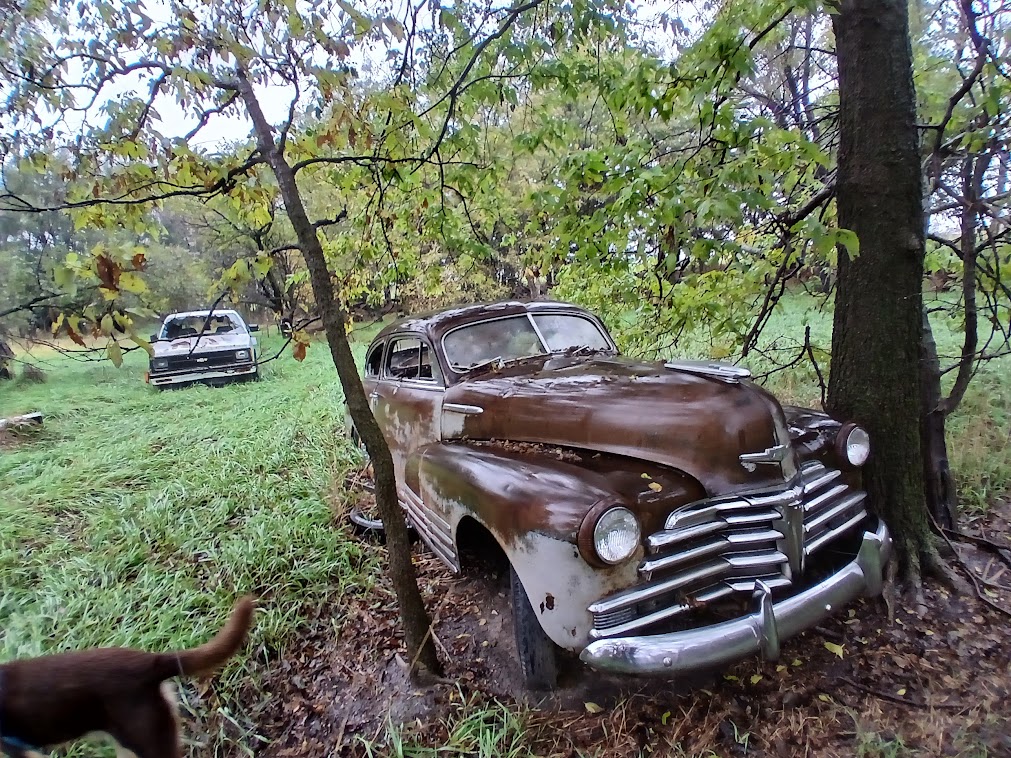
He had all these wrecked cars around this shack where he lived. I’d see a dog coming and I’d jump up on the hood of a car and he’d hear the commotion and he’d come out. I really liked seeing those kinds of people. That man would make his rounds through Black Hawk and Central City (before it became a casino and gambling town) and all the butchers knew him. He’d come in a couple of times a week and get bones and scraps, because he couldn’t afford to feed them, otherwise. He’d gather all the scraps from various butchers . . . they still had butchers in those towns at that time.
On what basis did you see those people?
They were old people receiving pensions, and my job was . . . I guess I was mandated to see them at least once a month, because at that point if they were receiving an old-age pension, it was kind of to make sure they were OK and in good health and all that kind of stuff.
Did they seem to like seeing you?
Yeah, they did when they realized that I wasn’t going to try to trundle them into town every time they got sick, which had been their experience with previous social workers. These were tough old birds and they weren’t about to check into Mesa Vista sanitarium just because they were sick, you know. They wanted to stay up there, and I figured it was their business to do so.
Do you see a demographic change in the mountains? First you had the miners and a few big ranches up there. Then the hippies started moving up there in a “back to the land” movement. You might remember a woman who was living up there on Sugarloaf on National Forest land where she’d staked a mining claim and had a baby and two other young children. Boulder Public Library did a documentary film on her. She was run out of there by the Forest Service after other people complained that they wanted her off the land, even though she was living in an old miner’s cabin that had been there since the 1800’s. Although she had a legitimate mining claim, she was seen as a hippie and a squatter. I perceived it as a class-struggle issue, with the wealthy yuppies wanting the mountains only for people like themselves.
Yeah, well, I think a lot of those old people are gone. It’s sad, but the old miners, the original old mining families, have left and I think you said it earlier, but what you see is the most interesting people in the mountains now are sort of your older hippies who have settled in up there and stayed.
It’s interesting if you go in Ward, you’ll find out, most of the people who stayed in Ward and Nederland are from New York. They’ll stay up there for a few years and then they move into town, because it is difficult. A lot of the old mining people, well, it’s not the same in the mountains anymore. That’s too bad, I think.
I agree, and yet, I think those towns would have died and become ghost towns if there had not been new people coming in there. Nederland and Ward back in the ‘50s were populated by very old people. They were in their 80s and they’d been there from the mining days dating back to before World War I. There was a town called Tungsten beneath Barker Dam and now it’s gone. They weren’t rejuvenated. Tungsten had twenty thousand people in 1914.
Yeah. You see the graves. What you said about the hippies moving in, it was probably good because the towns were dying off. But at the same time, I can remember – I lived up on Magnolia road at the time of the big hippie movement and I used to go to Nederland to shop sometimes because it was closer than going to Boulder. I remember I went up there with my ex-wife and got attacked, really, by the guy in the drugstore. There was a little soda fountain there in the drugstore.
I remember the drugstore. They had a sign in the window that said they didn’t serve hippies. Were you a hippie?
No. I was pretty straight. I always looked pretty straight. I think I had a hippie philosophy about me, but I was a hippie incognito. My ex-wife and I went in there to get a milkshake and sat at those barstools and ordered some shakes. The lady that worked there was halfway through making the milkshakes when this young hippie couple came in with long hair. They were more hippie in dress than I was, and she was serving us because we looked pretty straight.
These people came in and she asked them to leave, and I said, “Well, if you’re not serving them, then I guess we’re not staying either.” Then we got up and started walking out and she starts screaming at us and we went out the door. She yelled, “Get out of here and take your sympathies somewhere else. Get out of my store!”
So somebody came in and I said, “Watch out. There’s a real bitch in there.” Her husband heard me say that while he was at one of the other places in the drugstore, and I just kept walking. He had a gun. He was wearing a sidearm, a pistol.
Were these older people?
Yes. They were older people. Basically, I think they were mad. I think they were real mad because I walked out when they kicked those other people out. He jumped on my back with his arms and legs and he yelled to people to “Get Jimmy, get Jimmy.” And Jimmy was the sheriff up there then, and I knew Jimmy because I lived up on Magnolia road. So I said, “Sure, go get Jimmy,” you know, the quicker the better. Because this guy, he didn’t pull his gun out or anything, but he had a sidearm and I wasn’t going to give him any static.
Jimmy came and just told him, “Yeah. I did that.” I mentioned that somebody’s wife was certainly acting like a bitch as I walked out the door. So he told me never to come back. I said “fine” and went on my way.
Magnolia Road was unpaved then. One thing you didn’t want to do if you were using the road – you didn’t want to be going up there early in the morning or down the road at night, because those of us who lived up there used to like to take up the whole road. We’d come down in a vehicle (sometimes) going sideways. After the first couple of snows it was OK since most of us had four wheel drive. If we started to slide off the road, we just purposely headed for a snow bank. You would be taking your life in your hands (if you were) going the wrong direction.
There was one woman with a baby who lived in a cave right by the road that you can still see if you go up there. It is not up to the town site of Magnolia, if you know where that is. It’s about half way up the road, Old Whisky Road, or something like that. Right across from Whisky Road is a mine shaft by the side of the road. This woman and baby lived in there for one full winter, and it was kind of funny, because I worked for Social Services at that point, yet Social Services was on her back all the time because they were mad at her, because here she was, living with this baby in this mine shaft in the mountains. She’d bring the baby in during the day, and she had day care arranged, and she was real good with the baby. In fact, I used to give her rides up and down because I’d see her about the time I went to work. She didn’t have a car or anything. But she spent a whole winter in that mine with her baby.
Was the baby healthy?
Yeah, the baby was healthy and everything, but people just didn’t like the way she was living. She couldn’t find a house or anything that she could afford. It wasn’t just that, it was the principle of the thing too. Remember the big scare among all the hippy people that San Francisco was going to fall into the ocean? That’s why a lot of them were up there.
Were they living in Dream Canyon up on Sugarloaf Mountain?
Yes. They were sleeping in old wrecked cars. You know, they could drive them up there, but they couldn’t get them out. Some of them slept in tepees. Well, I was sleeping there for a couple of days. Everybody up there was smoking kinnikinnick, which was sort of the ground cover up there. They’d say it made them high, but all I ever got from the stuff was a sore throat.
Pot wasn’t as prevalent as it is today. So everybody was up there smoking kinnikinnick and they were very cool with that stuff. But I never got a rush from it, but I was told I would. It’s wild huckleberry. I would imagine it would be very hard on your lungs if you smoked a lot of it.
What was the attitude of the hippies back then to mainstream social workers?
(It was) very uptight . . . Very hostile. One summer I was assigned to the old hotel site, known as “The Ruins,” located where the Justice Center is today. My sole job at Social Services was to patrol that site. (All the hippies) were camping out there that summer and my job was to find anybody under the age of 18 and put them on a plane and ship them home, whether they were here with their parent’s permission or not. The whole idea was that anyone here from out of state(who) couldn’t prove residence – we were to identify them and to ship them back to where they came from.
They had a nice vegetable garden growing, and between the vegetables they had marijuana growing, and everybody was happy and getting along fine. Then the rednecks found out about it, and of course the great sport was coming in at night and tearing up the garden, including marijuana, radishes, and everything else that was in there. So it was a little game. The hippies would toil away during the day at their garden and the rednecks would come at night and tear it up. But that was a really good job (for me) you know, in a way. I never really went into the office and just wandered around and met a lot of good friends and talked to lots of people.
[To be continued as series of interviews with prominent Boulder residents. Each interview will be posted as a stand alone interview in coming days. — S. Byron Gassaway]
Recent Comments